The Process of Molela Clay Work: Traditional Craft & Techniques
Discover the 800-year-old craft of Molela clay work: sacred Banas river earth, hollow-relief sculpting, traditional bhaldi tools, and authentic kiln firing.
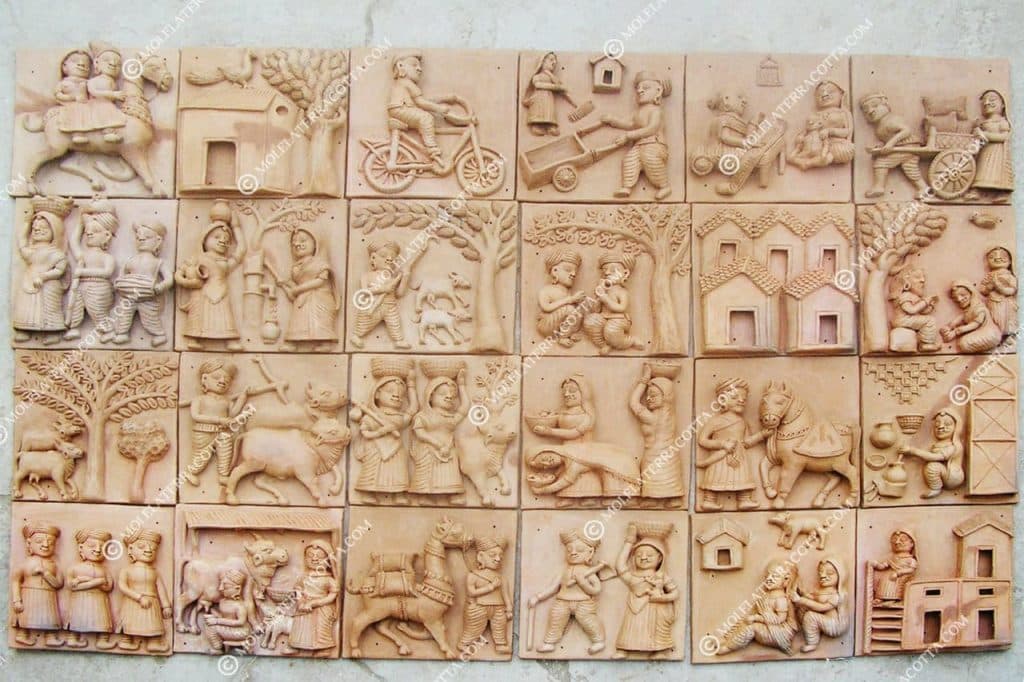
The Living Art: 800 Years of Earth and Hand
Molela clay work is among the earliest of human artistic creations, preserving an unbroken 800-year living lineage in the quiet village of Molela on the banks of Rajasthan’s Banas River. While most traditional terracotta across India and the world relies on the potter’s wheel (chak) or repetitive casting moulds (saancha), authentic Molela terracotta is distinguished by its 100% hand-sculpted hollow-relief technique.
Practised exclusively by the hereditary Kumhar artisan community, this craft was granted Geographical Indication (GI Tag No. 67) for its irreplaceable regional materials, indigenous tools, and sacred cultural roots. Every piece — from small devotional votive plaques of Lord Devnarayan and Bhairav Ji to monumental architectural terracotta wall murals — is hand-built on the studio floor through an intricate eight-stage process developed and passed down across twenty-seven generations.
The Raw Materials: Banas Silt, Donkey Dung & Natural Tempering
The chemical and mechanical integrity of Molela terracotta depends entirely on the unique mineral composition of local alluvial silt (mitti), gathered from the seasonal banks of the Banas River and natural catchment ponds such as Ahula Talai and Doran ki Naadi. This fine-grained clay possesses exceptional natural plasticity and mineral richness.
However, pure river silt shrinks unevenly and shatters under the thermal stress of high-temperature firing. To prevent this, master potters employ an ancient tempering secret: blending the raw clay with *donkey dung (leed or gadhe ki leed) in precise, time-honoured ratios. The raw clay is sieved through a wire mesh (chalni) to remove stones, mixed with the fibrous leed, soaked in water for 6 to 7 hours*, and then vigorously kneaded like dough by foot and hand until it achieves a smooth, uniform consistency.
The organic donkey manure is vital to the craft’s physics: during the 800°C–900°C kiln firing, the organic fibres incinerate completely, leaving an intricate network of microscopic pores. These micro-channels allow steam and expanding gases to escape safely without building internal pressure, granting the terracotta superior thermal shock resistance, elasticity, and structural longevity.
The Artisan’s Toolkit: Indigenous Hand Tools
The entire visual vocabulary of Molela clay work is executed using a minimal suite of handmade tools, crafted, sharpened, and maintained by the artisans themselves:
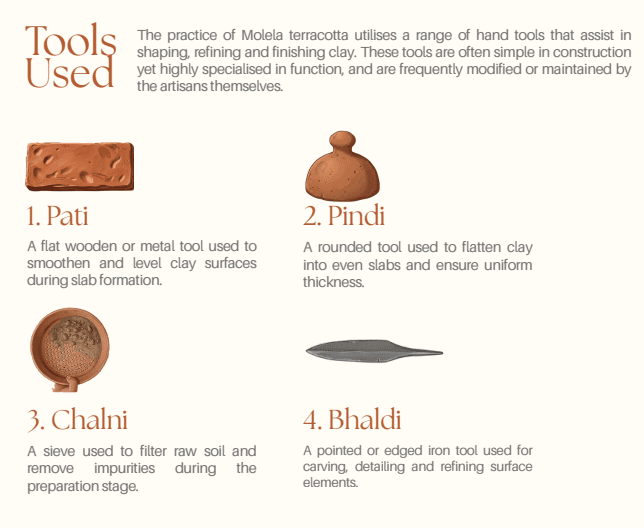
- Pindi (Rounded Wooden Mallet): A rounded hardwood tool used to pound and flatten the tempered clay onto the workshop floor, creating an even slab base of uniform thickness.
- Pati (Smoothing Tool): A flat wooden or metal blade used to level and smoothen the clay slab surface before sketching and sculpting begin.
- Bhaldi or Bhaladi (The Sculptor’s Stylus): The signature tool of the Molela artisan — a chisel-edged bamboo stylus or forged iron blade. It is used to incise fine facial features, carve jewellery, shape leaf veins, and define crisp contours where fingers cannot reach.
- Chalni (Sieve): A coarse wire mesh used to filter raw soil, removing pebbles, roots, and impurities during initial clay preparation.
- Wire Cutter & Knife: Thin metal wires and knives used to square slab edges into precise modular tiles (such as 18" x 18" canvases) and separate raw clay blocks.
- Bhatti (Indigenous Pit Kiln): A traditional open-top pit furnace built with brick and clay, layered with cow dung cakes, firewood, and rice husk for open-flame firing.
- Sigdi: A smaller or open firing structure used for controlled or small-scale heating and test firings.
The Eight Stages of Crafting: "Kanha: Radha Ki Aankhon Se"
To understand how a Molela terracotta mural comes to life, the creation of the celebrated "Kanha: Radha Ki Aankhon Se" multi-tile panel exhibit documents the complete eight-stage journey from raw Banas earth to finished architectural artwork:
Stage 1: Preparing the Terracotta Clay Base
The process begins by gathering alluvial silt (mitti) from the Banas river basin. The dry clay is broken into uniform particles, sieved through the wire mesh (chalni) to remove stones and roots, and blended with *donkey dung (leed). Water is added, and the mixture is left to rest for 6 to 7 hours* before being vigorously kneaded by foot and hand into a smooth, pliable clay dough.
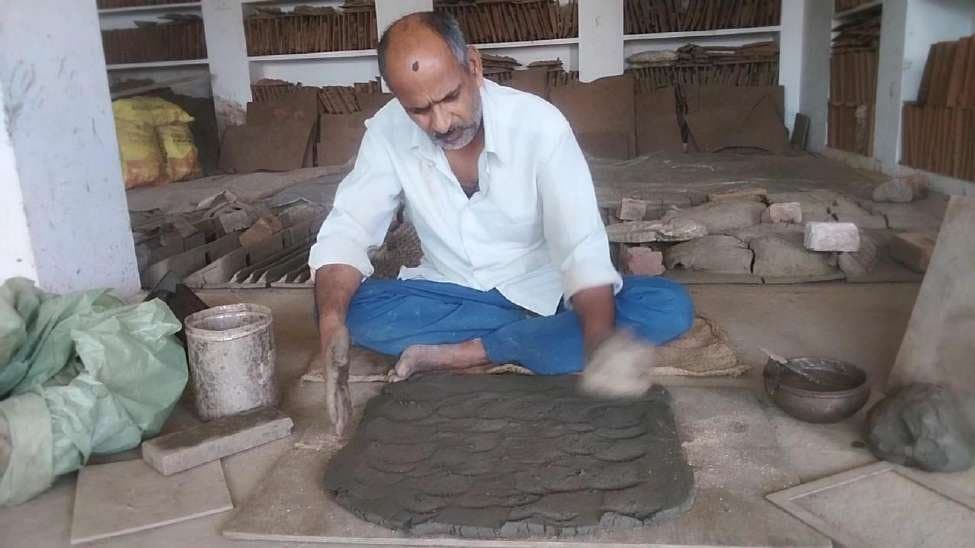
Stage 2: Cutting the Clay Base to Modular Canvas Size
The prepared clay is spread onto the workshop floor and beaten flat with a rounded hardwood mallet (pindi). A flat wooden tool (pati) is used to level the surface to an even thickness. Using a wire cutter and knife, the slab is precisely trimmed to the modular canvas dimensions — typically 18 inches by 18 inches for architectural mural panels.
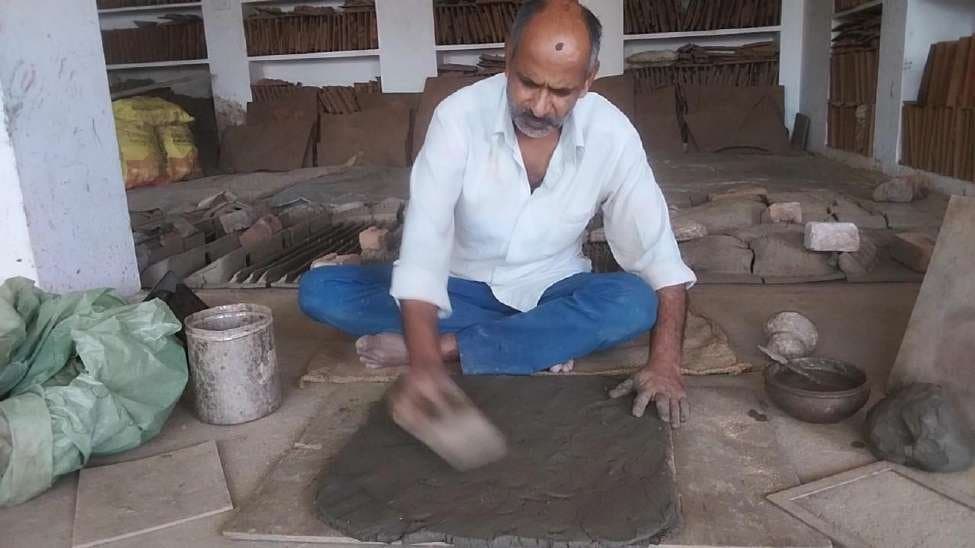
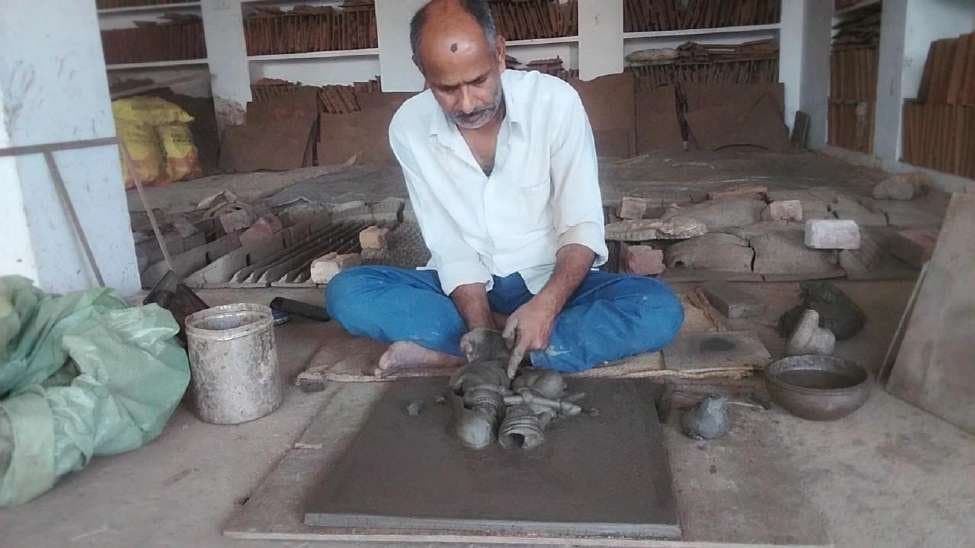
Stage 3: Hand-Sculpting Central Radha & Krishna Figures
With the canvas prepared, the master artisan begins sculpting the central deities entirely by hand without moulds (saancha). Using additive pinch-and-coil techniques, the divine figures of Radha and Krishna are modelled in three-dimensional relief directly onto the wet slab, building up expressive postures, headwear, and divine contours.
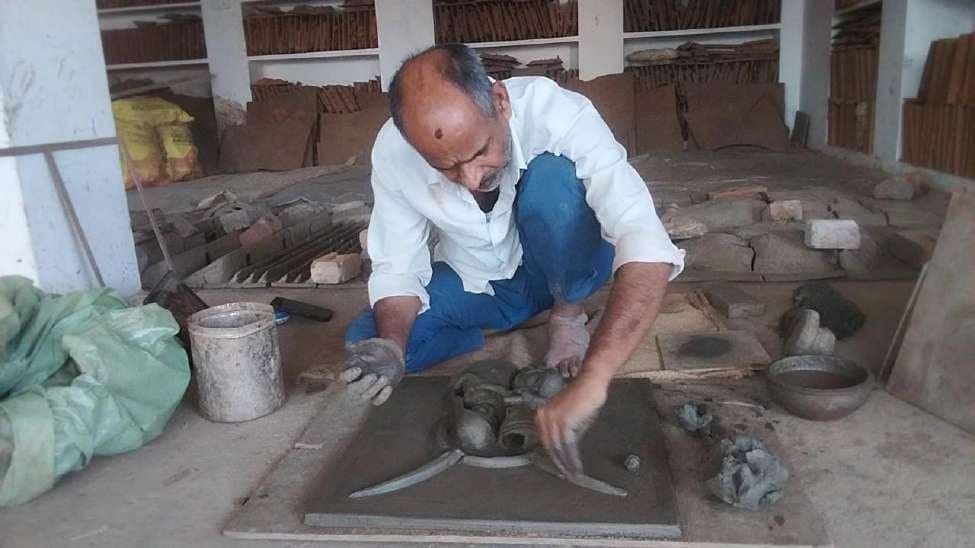
Stage 4: Sculpting Handcrafted Nature & Folklore Background
Around the central deities, the artisan weaves a rich narrative universe of rural folklore, echoing themes found in our village life terracotta tiles. Hand-modelled cows, calves, Kadamba trees, peacocks, floral garlands, and traditional temple arches (toran) are sculpted to frame the divine figures, creating depth and storytelling layers.
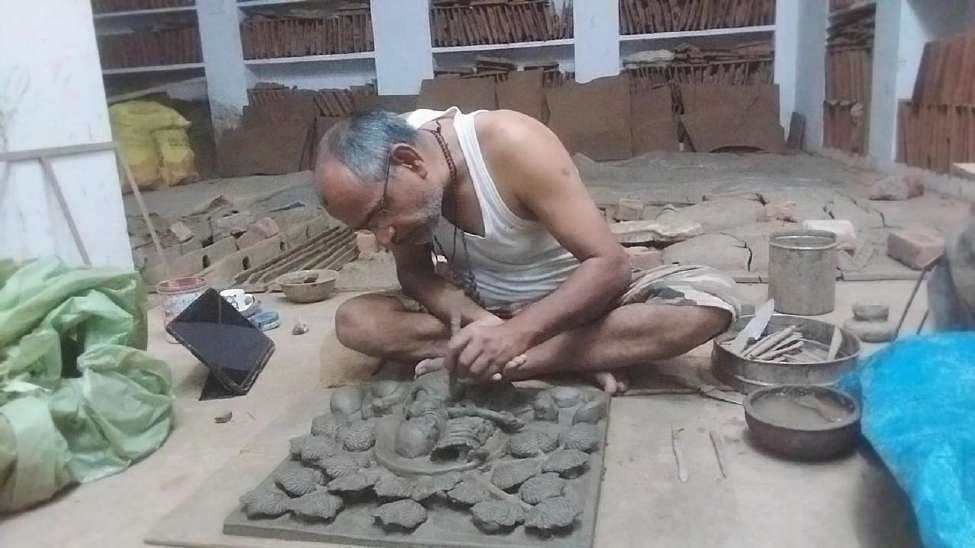
Stage 5: Refining Fine Details with the Bhaldi Stylus
Using the signature bhaldi (bamboo or iron chisel-knife stylus), the artisan carves crisp outlines, incises detailed facial features (large expressive eyes, lips), delicate jewellery ornaments, and intricate textures on garments and tree leaves where fingers cannot reach.
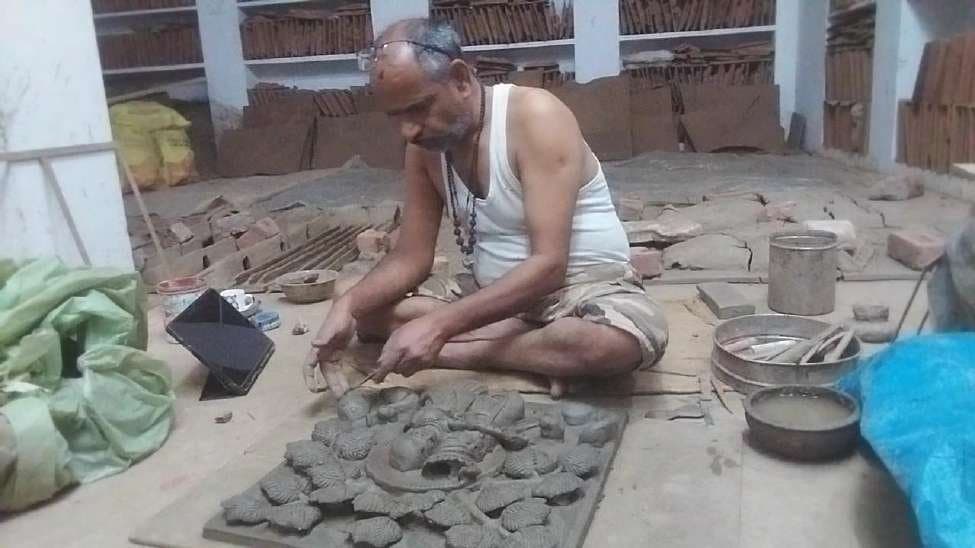
Stage 6: Completing the 18" x 18" Canvas with Hollow Backing
Once sculpting is complete, the surface is smoothed with moist fingers and light tools. Crucially, the rear of all raised figures is carefully hollowed out from behind. This ensures a uniform wall thickness of 1.5 to 2 cm, preventing moisture entrapment and reducing tile weight by over 40%.
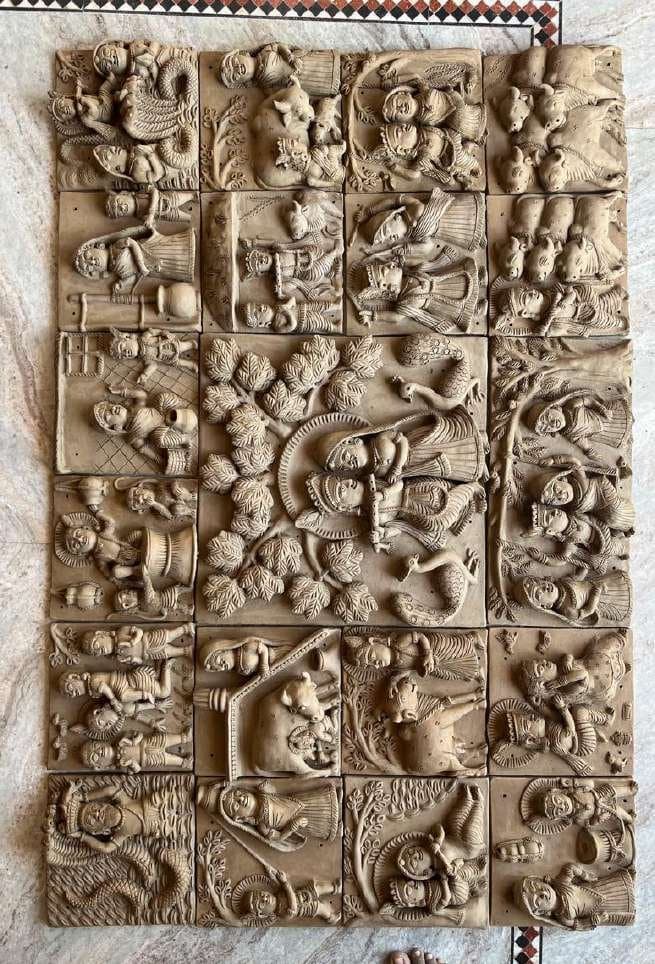
Stage 7: Courtyard Assembly of the Unbaked Mural & Shade Drying
Before firing, all individual modular tiles are assembled together on the courtyard floor. The artisans inspect the entire composition to verify that connecting lines, tree branches, and decorative borders align flawlessly across tile joints. The unbaked mural is then left to dry slowly in shaded rooms for 4 to 5 days.
Stage 8: Kiln Baking (Bhatti) & Final Terracotta Finish
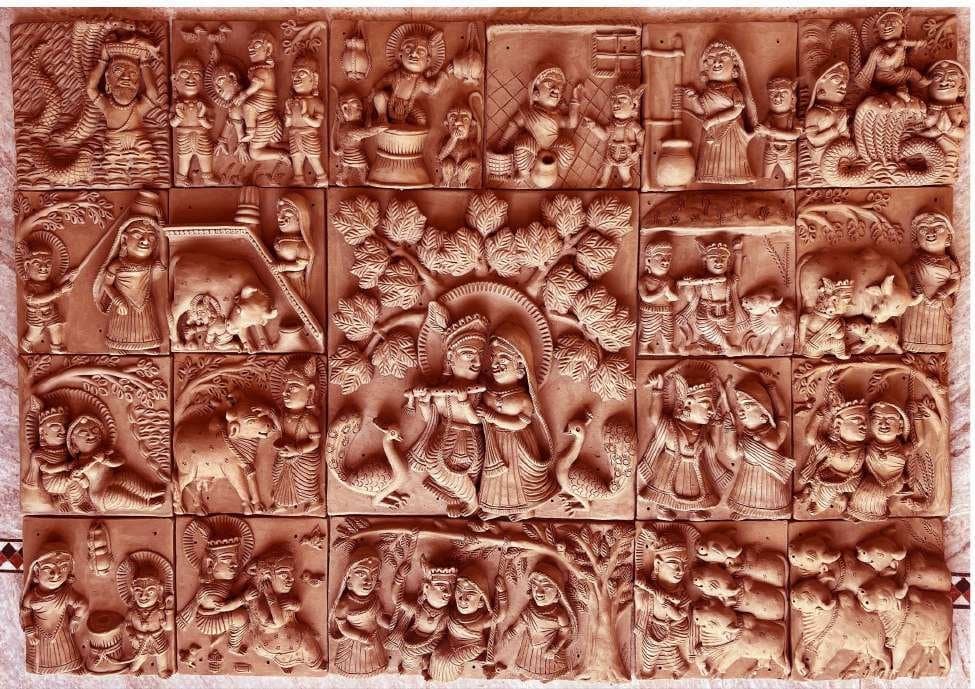
The bone-dry panels are carefully stacked inside the open pit furnace (bhatti), cushioned with cow dung cakes (kande), firewood, and rice husk. Fired for over 12 hours at temperatures between 800°C and 900°C, the tiles emerge in their timeless terracotta-red finish, ready for installation or treatment with natural geru and khadiya.
Hollow-Relief Engineering: Why Molela Murals Never Crack
A central engineering marvel of Molela terracotta is its *hollow construction (hollow relief). Unlike stone or wood carvings that are subtractive, or commercial ceramic castings that are solid, Molela artisans build 3D figures additively on the front and then scoop out the clay from behind*.
This hollow cavity serves two indispensable engineering purposes: it dramatically reduces the weight of large architectural panels (making them easy to ship and mount on interior and exterior walls), and it ensures the clay walls have a uniform thickness of 1.5 to 2 centimetres. Because there are no thick solid cores to retain moisture, the tiles dry evenly and expand uniformly in the kiln without thermal cracking.
Kiln Firing (Bhatti) & Natural Pigment Finishes
Firing takes place in an indigenous open pit furnace known as the bhatti. The dried plaques are stacked vertically and cushioned with dried cow dung cakes (kande), local firewood, and rice husk. The kiln is covered with broken pottery shards and mud to retain heat, and fired for over 12 hours until the temperature reaches 800°C to 900°C.
After slow cooling, the tiles emerge in their signature warm terracotta-orange colour. Traditionally, plaques are treated with Geru (natural red ochre earth) and accented with Khadiya (white lime wash) or natural lac varnishes. For contemporary architectural projects, murals can be left in their natural unglazed terracotta tone, sealed with weatherproof matte sealants, or hand-painted with custom mineral palettes. Enthusiasts and institutions can also practice these techniques with our Molela Terracotta Workshop Clay Kit.
Frequently Asked Questions
Questions & Answers about Molela Clay Work
Key insights into the sacred origin, traditional techniques, and cultural significance of Molela terracotta.
What is the step-by-step process of making Molela clay work?
Molela clay work follows an eight-stage process: (1) Clay preparation and donkey dung tempering; (2) Cutting the clay slab to modular canvas size (e.g. 18" x 18"); (3) Sculpting central figures by hand; (4) Adding background nature motifs; (5) Detailing with the bhaldi stylus; (6) Hollowing out the rear relief; (7) Assembling modular unbaked panels and shade drying for 4–5 days; and (8) Open-pit kiln firing (bhatti) at 800°C–900°C.
Why is donkey dung (leed) mixed into Molela terracotta clay?
Donkey dung (leed)* provides natural organic fibres that burn away during the 800°C–900°C kiln firing. This creates microscopic pores throughout the clay that allow moisture and expanding gases to escape safely, preventing thick relief panels from cracking or warping under thermal shock.
What is the traditional bhaldi tool used for in Molela clay work?
The bhaldi (or bhaladi) is a small, chisel-edged bamboo or iron tool. It is the artisan’s primary sculpting instrument, used for incising fine lines, carving eyes and facial expressions, detailing jewellery and garments, and shaping intricate floral and tree patterns.
Why are Molela terracotta plaques hollow from behind?
Raised figures are sculpted hollow from behind to maintain a uniform wall thickness of 1.5 to 2 cm across the entire plaque. This ensures even drying, reduces overall weight by 40%, and allows heat to circulate freely in the kiln, preventing trapped moisture from shattering the artwork.
How long does it take for a Molela terracotta mural to dry and fire?
After sculpting, the unbaked clay panels dry slowly in shaded, well-ventilated rooms for 4 to 5 days to prevent shrinkage cracks. They are then fired in the bhatti kiln for approximately 12 to 14 hours at temperatures between 800°C and 900°C.
Can Molela terracotta murals be customized for modern homes and architectural projects?
Yes. Because Molela terracotta is modular (crafted in individual tiles like 18" x 18" or custom dimensions), murals can be customized to any wall size. National Awardee Dinesh Chandra Kumhar and family create bespoke panels depicting traditional folklore, village life, or custom contemporary themes for homes, hotels, and airports worldwide.
Want a piece in this style?
Every plaque and mural is made to order in the size you need. Send a reference or a wall measurement and we will quote for it.